&w=3840&q=80)

Despite recent updates in legislation and increases in awareness, accessibility continues to be treated as an afterthought in the development process. It’s still too often viewed as a nice-to-have rather than an integral part of a well-functioning software product.
Many of Agiledrop’s developers have honed their accessibility skills on high-level projects and actively pass their knowledge on to their team mates.
Still, we wanted to take this understanding of the importance of accessibility to the next level, so that all of our developers can proactively prioritize it in future projects they work on, spearheading accessible development for all of our clients’ websites and applications.
In previous years, we mostly worked with Drupal, which heavily prioritizes accessibility with many accessibility features available by default. As our tech stack evolved with technologies that don’t treat accessibility with the same level of default care, we realized that some additional accessibility training would be useful.
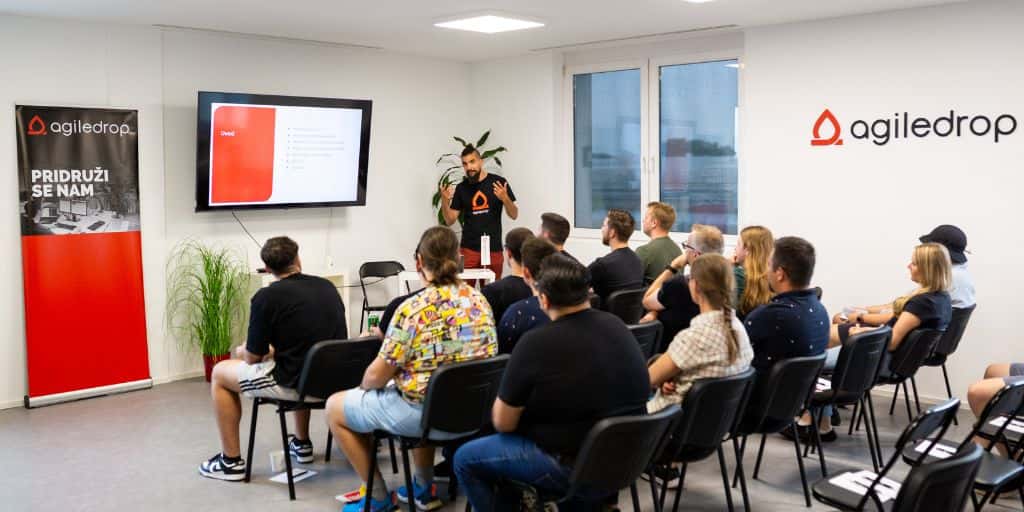
To this end, we organized an internal hackathon where our developers could collaboratively work through specific accessibility challenges under the guidance of our development managers and accessibility experts.
This was the first hackathon that we organized internally, and we wanted it to emphasize learning, which is an integral value of our company culture. The main goal of the event was to bring the topic of accessibility closer to developers and promote the understanding of accessible development being more than just a legal requirement.
The participants split into teams of two, if possible one front end and one back end developer. The first part involved performing common website tasks as a person with a disability, e.g. by using a screen reader simulator and other constraints such as keyboard-only navigation and grayscale mode. The second part then required fixing deliberately included accessibility issues of varying severity.
Feedback from our developers clearly shows that this initial hackathon was a success. They appreciated the more engaging format (compared to our traditional AgileTalks, which are much more one-sided), and even back-end developers appreciated the frontend-related learnings.
Some of the responses reflected a newfound understanding of why digital accessibility is so important, and how it is not just something to be done simply for the sake of doing it. A few team members specifically highlighted how much easier it is to implement accessibility when it’s done from the start rather than tagging it on at the end of the development process.
The key takeaway was that accessible design and development allow a digital product to be optimally used by every user, no matter any temporary or permanent limitations they may have. Critically, small changes can go a long way in drastically improving the experience of a person with a disability such as impaired vision.
For some of our developers, this learning-oriented hackathon served as a real eye opener on how exactly to approach designing and developing digital experiences for people with disabilities.
One developer noted that they had always consistently implemented accessibility features, but mostly because it had been required; now, they have a much keener understanding of the tangible importance of features such as alternative text, button descriptions, etc.
The main outcome we wanted to achieve with this initiative was to implement accessibility as a standard practice in front end development. We believe that more of our developers who are acting as lead developers and technical leads on client development teams will now be taking this step, as well as sharing their newfound learnings with clients’ developers in order to make optimizations even on projects and in cases where we’re not actively collaborating.
Additionally, we are planning on making accessible development a more prominent part of our onboarding programs to continue nurturing our strong culture of knowledge sharing, which is a boon to both clients and team mates.
Accessibility is not about making perfect websites and applications. It’s about not blocking people from using them.
In case you're experiencing issues with accessibility, apply for an accessibility audit here, or reach out to us directly if you have more specific accessibility needs.