&w=3840&q=80)

It’s no secret: I love Drupal. Now that I got that off my chest, I need to share my excitement about a special version of Drupal called Drupal CMS.
You might say that Drupal has been a CMS all along. Drupal is indeed an open-source content management framework, valued for its flexibility and power. With Drupal we, the developers, can build a wide range of web applications that handle complex workflows, e-commerce, multilingual content, and more. Let me reiterate the key part of this definition: “developers can build web applications”.
Drupal is endlessly extensible, but its complexity is driving most users away. Small business owners or individuals looking for straightforward website creation therefore prefer to turn to the no-code or low-code platforms.
To bridge this gap, Dries Buytaert, the founder of Drupal, announced a modern, modular, "plug-and-play" approach to Drupal in May 2024. Drupal CMS is faster to start, cleaner to extend and easier to deploy. Let us dive into what makes it different, why it matters, and how it performed when I put it to the test.
Drupal needed a refurbishment
Drupal is resilient, but it’s also overwhelming. There’s a lot to grasp: content types, modules, views, blocks, menus to name a few. The steep learning curve is the major critical challenge.
A recent Storyblok survey found that 67.5% of developers believe their current CMS “hinders” performance and productivity, with nearly half citing it as a “constant” issue. Only 4% consider their CMS a “perfect” fit. In the same survey, 58% of senior developers in medium-to-large firms were considering quitting because of legacy tech stacks, with outdated CMSs featuring among the top grievances.
As for the Drupal market share, according to W3Techs data, it has shrunk by 25% since 2024. W3Techs reports Drupal currently runs on 0.8% of all websites, representing only 1.1% of known CMS-powered sites. It has now been overtaken by fast-growing builders like Wix and Squarespace.
Why are developers leaving Drupal? The long setup with Drupal Core and Drupal’s custom architecture are a perfect ground for frustration. Meanwhile frameworks such as React and Next.js along with headless CMS are much more tempting alternatives. The 2024 StackOverflow Developer Survey revealed a mere 0.9% of developers love Drupal, compared to over 30% for frameworks like React or Node.js.
When it comes to the open-source CMS market, WordPress powers approximately 43% of the internet, while Drupal holds about 1.2% of the global CMS market share. While the two platforms serve different needs rather than directly competing, Drupal has traditionally emphasised its strengths in security, scalability, and handling complex, enterprise-level requirements.
Meanwhile, WordPress has gained widespread adoption through its intuitive interface and ease of use for beginners and non-technical users. The new Drupal CMS initiative rewrites the rules by combining Drupal's robust architecture with improved user experience, making the platform more accessible without compromising its core strengths.
Enter Drupal CMS
Announced in May 2024 as part of the Drupal Starshot Initiative, Drupal CMS aims to reverse the trend. It is still Drupal at its core, but with a faster, cleaner, and more modular experience:
- One-click install with
npx create-drupal-cms my-project - Initial setup time reduced by 95% (from over 30 minutes to less than 2 minutes)
- Smart defaults and pre-configured content types for common use cases
- Optimised performance settings and caching that actually works
- Backward compatible with Drupal 11
The secret Recipes
A major innovation in Drupal CMS is Recipes, pre-built configurations that set up complete features in seconds. I was quite excited to learn that the local installation using DDEV remains rather similar. The only difference is that drupal/cms package is to be used from Composer as opposed to drupal/recommended-project:^11 for the latest core Drupal:
mkdir agiledrop-drupal-cms

cd agiledrop-drupal-cms

ddev config --project-type=drupal --docroot=web --create-docroot

ddev start

ddev composer create-project drupal/cms

ddev launch
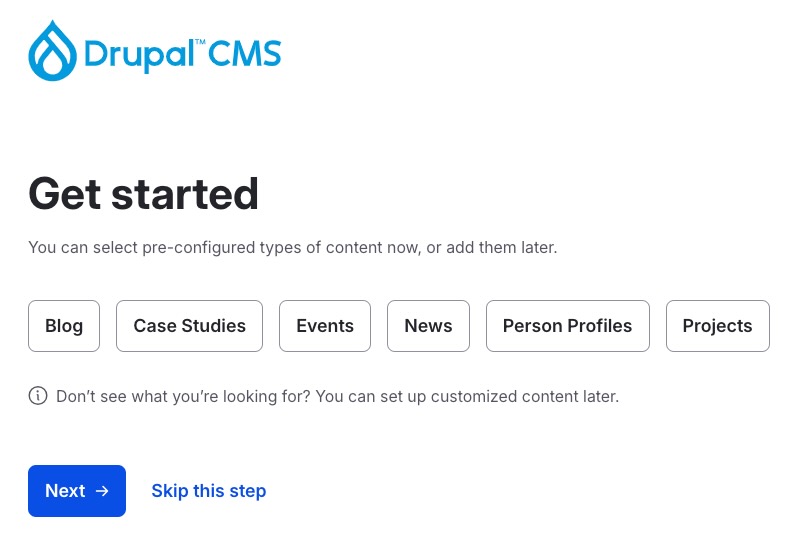
As soon as the site is launched, the page with several Recipes’ options appears:
- Blog
- Case Studies
- Events
- News
- Person Profiles
- Projects
However, there are already numerous contributed Recipes available that can support your needs. Recipes thus effectively replace the traditional monolithic Installation Profiles. Applied exclusively during initial site installation, Installation Profiles are permanent. They lock the site into specific configurations that are difficult to modify post-installation.
As for the lightweight Recipes, they can be applied to a Drupal site as configuration at any time. Want to add a blog? Run a recipe. Need e-commerce? Run a recipe. As they don’t lock sites into the limitations of specific distributions or installation profiles, Recipes can be stacked, combined and shared.
What happens in Drupal stays in Drupal
Drupal CMS system remains entity-based, meaning that everything feels familiar – content types, views, routes, services – but now it’s optional and progressive. Simply plug in what you need and skip what you don’t without breaking the core. We could say that there are three levels of customisation in Drupal CMS:
- Configuration-based: drag-and-drop layouts, visual content type builder, theme customization through UI, etc.For non-developers and rapid prototyping.
- Lightly code-enhanced: custom themes, limited front-end overrides, etc. For developers who want control without complexity.
- Complete system override: custom entities, advanced workflow implementations, third-party services integrations, etc. For enterprise and advanced developers.
The beauty of Drupal CMS is that it does not lock you into default behavior. It offers a progressive enhancement approach and full backward compatibility with Drupal 11.
Play it by ear
I approached Drupal CMS with some distrust. I like my workflows. I like control. But I quickly realized that I can still use Drush, Composer and DDEV, just the way I am used to with traditional Drupal.
To play with Drupal CMS I first enabled the Blog Recipe. Then I fiddled with the front end as well as the back end. To test the front-end customization, I wanted to quickly simplify and embellish the blog teasers. I created a custom theme with a Twig template and a CSS file.
To test the backend customization, I created a silly custom module Elephant in the Room. I enabled the module on the CMS 1.0 site just like I always do: ddev drush en elephant_in_the_room. My entire workflow for customization, from creating themes to enabling modules with Drush, remained completely unchanged.
To my surprise, the automated configuration provided by the Recipes had a significant impact on my development time. In the end, the entire site-building process proved to be 70% faster than my usual Drupal workflow.
Case studies
Drupal CMS is still new, so case studies are scarce. One showcase is defendpublichealth.org, built by the Drupal Association. If you right-click and inspect the page and check the <head>, you can see content="Drupal 11 (https://www.drupal.org)" under <meta>. That aligns with Drupal CMS being "built on Drupal core".
You can also note that a custom theme was created along with the custom CSS and JavaScript code. While no obvious “recipe” markers are visible in the source code, it demonstrates the approach in action.
Business Impact
Here is how a typical business website project with 2 developers and a timeline of 8 weeks can benefit from Drupal CMS.
Traditional Drupal
16+ weeks
- Setup and configuration: 2 weeks
- Custom content types: 4 weeks
- E-commerce integration: 6 weeks
- Optimisation and testing: 5+ weeks
Drupal CMS
6 weeks
- Initial setup: 1 day
- Content modeling with built-in e-commerce: 1 week
- Custom business logic: 3 weeks
- Integration and testing: 2 weeks
Result
- 62% faster development
- €50,000 saved in development costs
Why it matters
Drupal CMS is not just a streamlined installer, it is a strategic evolution of the Drupal ecosystem. By combining smart defaults, modular recipes and full compatibility with Drupal 11, it reduces the barrier to entry while preserving the extensibility that enterprises rely on.
The initial setup time is reduced by 95%, from over 30 minutes to just 2 minutes. With the intuitive UI the content modeling time is reduced by 60% compared to the entire traditional code generation. And, thanks to the modern CSS framework integration, the theme development time is reduced by 40%.
As a developer, I tend to focus on code and workflow rather than marketing promises. But the broader impact of Drupal CMS is clear. It addresses an enduring tension in the Drupal ecosystem by combining power with accessibility, enabling rapid development without sacrificing enterprise-grade reliability. It delivers flexibility where it matters, while guiding teams toward best practices that reduce technical debt and improve long-term maintainability.
Time
- Initial setup: -95%
- Content modeling: -60%
- Theme development: -40%
- Deployment: -80%
Business
- Prototype to production in weeks, not months
- Iterative development without technical debt
Cost
- Lower onboarding costs for new developers
- Reduced maintenance overhead